Allows controlling several settings of a Domain. To open this item, right-click the E3 Admin icon on Windows Notification Area, select the Domain - Options  option to open the window on the next figure, and then click the Properties tab.
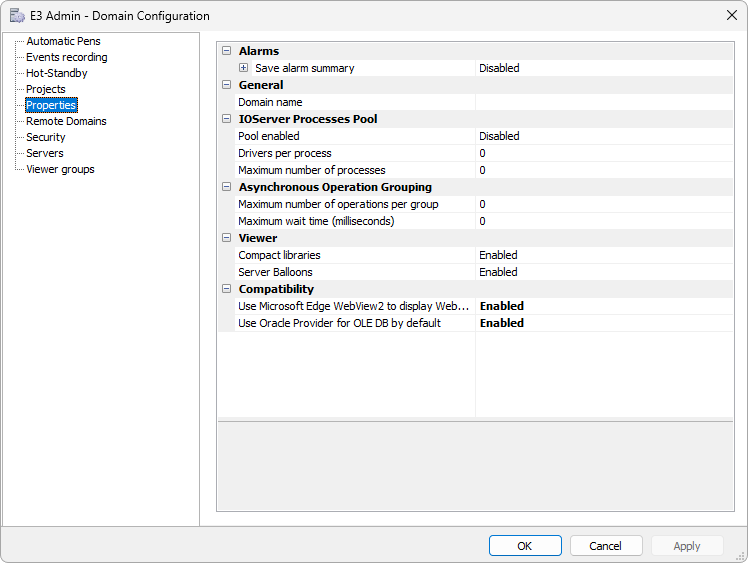
Properties tab
The Alarms group contains the Save alarm summary option, which allows saving the Alarm Summary and therefore avoiding duplicated Alarm notifications when opening or closing a Domain. By default, this option is disabled. To enable it, select the Enabled option on the Enable item and then specify a time interval, in minutes, in the Time interval option. The default time interval of this option is 1 (one) minute. These saved Alarms are loaded whenever a Domain is opened and saved in the interval specified in the Time interval option or whenever a Domain is closed. Saving Alarms is not performed when stopping or executing a Domain, because the Alarm Summary is kept in memory.
NOTES |
•In the case of servers in Hot-Standby mode, both servers persist the Alarms. •Only Alarms visible in the Summary are persisted. •When disabling this option, the previously persisted Alarms are deleted, to prevent outdated information when enabling this option again. |
The General group contains the options described on the next table.
Available options on the General group
Option |
Description |
|---|---|
Domain name |
Allows configuring a friendly name for a Domain. If this option is left blank, it is considered that the name of a Domain corresponds to the name of a Domain file without its .dom extension. This name is available via script at run time by using the Domain property of the Domain Information object, such as "Application.GetObject('[?Server].Domain').Domain" |
Time zone adjustment in communication channels |
Allows enabling a timezone adjustment of dates sent or received in communications with other servers or clients. Configuring this option with the value Disabled (default) implies that Elipse E3 assumes that all connected servers and clients are on the same timezone. Please check the next text for more information on how this option works |
Enabling the Time zone adjustment in communication channels option implies in the following behavior:
•All communication started after enabling this option perform a timezone adjustment if the computers involved have different timezones
•For a timezone adjustment to occur, it is enough that one of the computers involved has this option enabled
•Dynamic switching timezones is not supported, that is, values with a DATE data type, even when in Variant-type variables or inside Arrays, have their timezone adjusted to the timezone of the moment the communication channel was started
The following exceptions apply:
•A value of 0 (zero) does not have a timezone adjustment
•Values between 0.0 and 1.0, not included, are considered as counters of hours, minutes, and seconds, such as the RepeatInterval property of a Timer Tag, and they are not adjusted
•Values already in UTC (Coordinated Universal Time) format, such as the EventTimeUTC field from the Alarms table, are not adjusted
•Date and time values transmitted in Double format are not adjusted
•Values in UTC format contained in variables with a Variant data type or returned by properties or methods of remote objects are adjusted, such as when a Viewer reads the EventTimeUTC property of an Event object of a Collection of Events from a server
The IOServer Processes Pool group contains the options described on the next table.
Available options on the IOServer Processes Pool group
Option |
Description |
|---|---|
Pool enabled |
Enables or disables the pool of processes of I/O Servers. NOTE: Make sure that all Drivers in use in an application support this pool of processes feature, that is, Drivers must be compiled with IOKit version 2.0.6 or later. Drivers that do not support this feature must be configured with their DisableIOServerPool property in True. The default value for this option is Disabled. NOTE: Configuring this option with the Enabled value requires that at least one of the next options, Drivers per process or Maximum number of processes, have a value different from 0 (zero) |
Defines the maximum number of Drivers that execute on each I/O Server process. The default value of this option is 50 and the allowed values range between 2 (two) and 200 |
|
Defines the maximum number of I/O Server processes created by this pool. The value 0 (zero, default) in this option allows an unlimited number of processes. NOTE: If this option is configured to a value different from 0 (zero) and the value of the Drivers per process option exceeds the expected number for processes, the value of this option is adjusted at run time to fit the exceeding Drivers |
This configuration can be changed while a Domain is executing, but it only affects Drivers started after that change, or in the situations in which a Domain is updated:
•By clicking Saves and Runs the Domain  in Elipse E3 Studio
•By selecting the Domain - Refresh  option on E3 Admin menu on Windows Notification Area
•By generating an event forcing E3Run to receive the configuration of a Domain
NOTE |
For more information, please check topic Pool of I/O Server Processes on chapter Drivers. |
The Asynchronous Operation Grouping group contains the options described on the next table.
Available options on the Asynchronous Operation Grouping group
Option |
Description |
|---|---|
Defines the maximum number of operations per I/O Driver stored on E3Run's memory before sending them to an I/O Server. The default value of this option is 1000. Configuring this option with the value 0 (zero) disables grouping asynchronous operations. Possible values for this option range between 2 (two) and 100000 |
|
Defines the maximum time, in milliseconds, an asynchronous operation can wait in E3Run before it is sent to an I/O Server. The default value of this option is 50. Configuring this option with the value 0 (zero) disables the maximum waiting time. Possible values for this option range between 10 and 10000 |
The Viewer group contains the options described on the next table.
Available options on the Viewer group
Option |
Description |
|---|---|
Compact libraries |
Enables or disables compressing ElipseX library files for sending to an Elipse E3 Viewer. The default value of this option is Enabled, that is, the file is defragmented and the objects not used by the Elipse E3 Viewer are removed, thus decreasing the file size. If this option is disabled, the library files are sent without changes |
Server Balloons |
Enables or disables displaying a window with E3 Server's active warnings on Elipse E3 Viewer, such as license problems. This window can be closed or minimized, but it is opened periodically while there are active warnings. The default value of this option is Enabled |
The Compatibility group contains the options described on the next table.
Available options on the Compatibility group
Option |
Description |
|---|---|
Use Microsoft Edge WebView2 to display Web content |
Enables or disables using Microsoft Edge's WebView2 control as the rendering engine to display Internet content. This option is applied when starting Elipse E3 Viewer and its default value is Enabled |
Enables or disables using Oracle Provider for OLE DB by default on new Database objects. If this option is changed while a Domain is in use in Elipse E3 Studio, users must close and open this Domain again for this change to take effect. At run time, users must execute the Domain for this change to take effect. The default value of this option is Enabled |
|
Enables or disables using timestamps in UTC (Coordinated Universal Time) format in Alarms. In applications created in versions previous to 7.0, the value of EventTime and EventTimeUTC Alarm Fields is the same, regardless of timezone. When opening those applications in version 7.0, this behavior is kept, that is, this option is enabled. The default value of this option is Disabled, that is, the value of the EventTimeUTC Alarm Field corresponds to the timestamp of the EventTime Alarm Field adjusted to the UTC format |
The Database group contains the options described on the next table.
Available options on the Database group
Option |
Description |
|---|---|
Cached queries usage |
Allows globally enabling or disabling the usage of Queries in cache. Possible values for this option are Default: Obeys the configuration of each Query, Enabled (globally): All Queries work as if the CursorLocation property was configured with the value 2 (two, clCached), regardless of their individual configuration, or Disabled (globally): All Queries work as if the CursorLocation property was configured with the default value 1 (one, clClient), regardless of their individual configuration. For more information about this option, please check the next notes |
Maximum query cache size (rows) |
Maximum number of rows in cache for Queries whose CursorLocation property is configured with the value 2 (two, clCached). The default value of this option is 0 (zero, unlimited) and the maximum value is 20000. For more information about this option, please check the next notes |
Maximum query cache size (kilobytes) |
Maximum size, in kilobytes, stored in cache for Queries whose CursorLocation property is configured with the value 2 (two, clCached). The default value of this option is 256 and possible values range between 64 and 10000. For more information about this option, please check the next notes |
•If the Cached queries usage option is configured with the value Disabled (globally), this configuration can be overwritten in a specific Query by configuring the QueryCacheOverrideDomainConfig property to True. •If the Cached queries usage option is configured with the value Enabled (globally), the results of a Query are downloaded to the client using that Query, such as E3Run or Elipse E3 Viewer, providing a performance improvement and avoiding locks in recurring Queries or medium- or small-size Queries. It is recommended using this option for Queries in which their results remain inside the limits configured in the Maximum query cache size (rows) and Maximum query cache size (kilobytes) options. For larger Queries there may not be significant benefits. In case of an E3Browser, users cannot reorder the results when using a Query with this option selected. •The Maximum query cache size (rows) option corresponds to the behavior of the QueryCacheMaxRows property of a Query when the QueryCacheOverrideDomainConfig property is configured to False (default). •The Maximum query cache size (kilobytes) option corresponds to the behavior of the QueryCacheMaxKBytes property of a Query when the QueryCacheOverrideDomainConfig property is configured to False (default). •As a general rule, the limits defined in the Maximum query cache size (rows) and Maximum query cache size (kilobytes) options are always used, except when the QueryCacheOverrideDomainConfig property is set to True. |