File Name |
DNPMirror.dll |
Manufacturer |
DNP (Distributed Network Protocol) |
Devices |
Devices compatible with protocol DNP 3.0 |
Protocol |
DNP 3.0 |
Version |
1.0.7 |
Last Update |
09-02-2025 |
Platform |
Win32 |
Dependencies |
IOKit version 2.0 or later |
Superblock Readings |
No |
Level |
31201 |
Introduction to DNP 3.0 Protocol
DNP Mirror Master & Slave Driver implements DNP protocol version 3.0 in Master and Slave modes, according to levels 2 (two) and 3 (three).
DNP (Distributed Network Protocol) is an open, non-proprietary communication protocol, based on specifications by IEC (International Electrotechnical Commission), adapted for use with highly secure applications, with a moderated speed and amount of data. It is extremely flexible and can be used on any hardware platform.
The model specified by ISO - OSI (International Standards Organization - Open System Interconnection) establishes 7 (seven) layers for a network protocol. IEC, on the other hand, specifies a simplified model, which contains only the Physical, Data Link, and Application layers. This model is called EPA (Enhanced Performance Architecture). The next figure shows the structure of that architecture and the communication system.
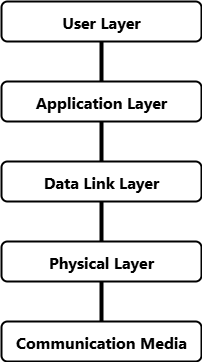
EPA structure
The User layer can be defined as the location where users manipulate data after all communications. In Elipse Software applications, this layer is represented by a user application. The User layer uses the Application layer of this Driver to send or receive full messages from and to a station.
The Application layer is responsible for specifying in details the requests from the User layer, and back to that layer when a message comes from the Data Link layer. In other words, this layer joins messages from the User layer, called fragments, into a message with multiple fragments with full information for processing and sending to a station by the Data Link layer.
The Data Link layer is used to send messages between primary, or origin, and secondary, or destination, stations. This layer also packs data, checks transmission errors, and sends this data to the TCP/IP network.