This Driver's [P] parameters are not used. All settings are performed on this Driver's settings dialog box. For more information about Setup, Serial, Ethernet, Modem, and RAS tabs, please check topic Documentation of I/O Interfaces.
The AnsiC12xx tab contains specific settings for this Driver.
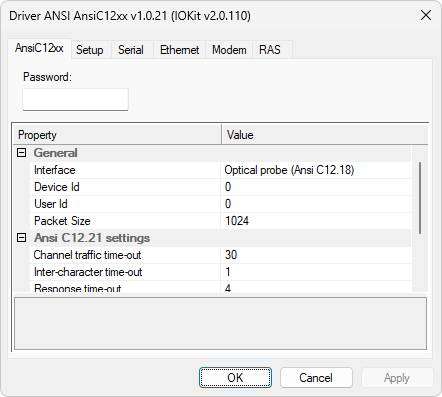
AnsiC12xx tab
The available options on this tab are described on the next table.
Available options on the AnsiC12xx tab
Parameter |
Description |
|---|---|
Password |
Password used as a way to select access permissions. This password is sent to a meter and then compared with the stored password to grant access to its tables. Its maximum size is 20 characters |
General - Interface |
Indication of a type of interface used by a meter to communicate. The available options are Optical probe (Ansi C12.18) or Modem (Ansi C12.21) |
General - Device Id |
Identifier of a device. Defines a value that identifies an ANSI C12.19 device on both request and response packets. The default value is 0 (zero) |
General - User Id |
User identifier. Defines a code, optionally stored by an ANSI C12.18 device, indicating the identity of the operator who requested the creation of a session. The default value is 0 (zero) |
General - Packet Size |
Maximum size of packets as the maximum number of octets that can communicate during transactions with a meter. The minimum value is 64 octets and the maximum value is 8192 octets. If a meter negotiates a lower value, the configured value is used as the size for requests to read segments from the ST-64 table. The default value is 1024 |
Ansi C12.21 settings - Channel traffic time-out |
Time-out of a channel's traffic, in seconds. The ending device finishes all communications after waiting for some time for a valid packet or confirmation. The default value is 30 and the minimum allowed value is 1 (one) |
Ansi C12.21 settings - Inter-character time-out |
Time-out between octets, in seconds. The packet's recipient must handle the case when a packet segment is lost. A time-out between characters is defined as the minimum amount of time a recipient must wait between characters within a packet when receiving data over the communication channel. The recipient must wait at least this time-out before stopping to wait for the remaining package and send a denied acknowledgment signal. The default value and the minimum allowed value are equal to 1 (one) |
Ansi C12.21 settings - Response time-out |
Time-out of a response, in seconds. The packet's sender must handle the case when a denied acknowledgment or confirmation is lost. A response time-out is defined as the minimum amount of time a sender must wait after a packet is sent to receive an acknowledgment over the communication channel. If this time-out elapses, the sender sends the packet again. The default value is 4 (four) and the minimum allowed value is 1 (one) |
Ansi C12.21 settings - Attempt retries |
Maximum number of retries. The default value is 3 (three) and the maximum allowed value is 10 |
NOTE |
The settings on the Ansi C12.21 settings group are only relevant when selecting the Modem (Ansi C12.21) item on the General - Interface option. |